


Brexit Regret in the UK: Reversing Brexit to Clean up the Mess, A Foggy Horizon
Recent polls reveal Brexit Regret in the UK. Public support in Britain for rejoining the European Union has reached
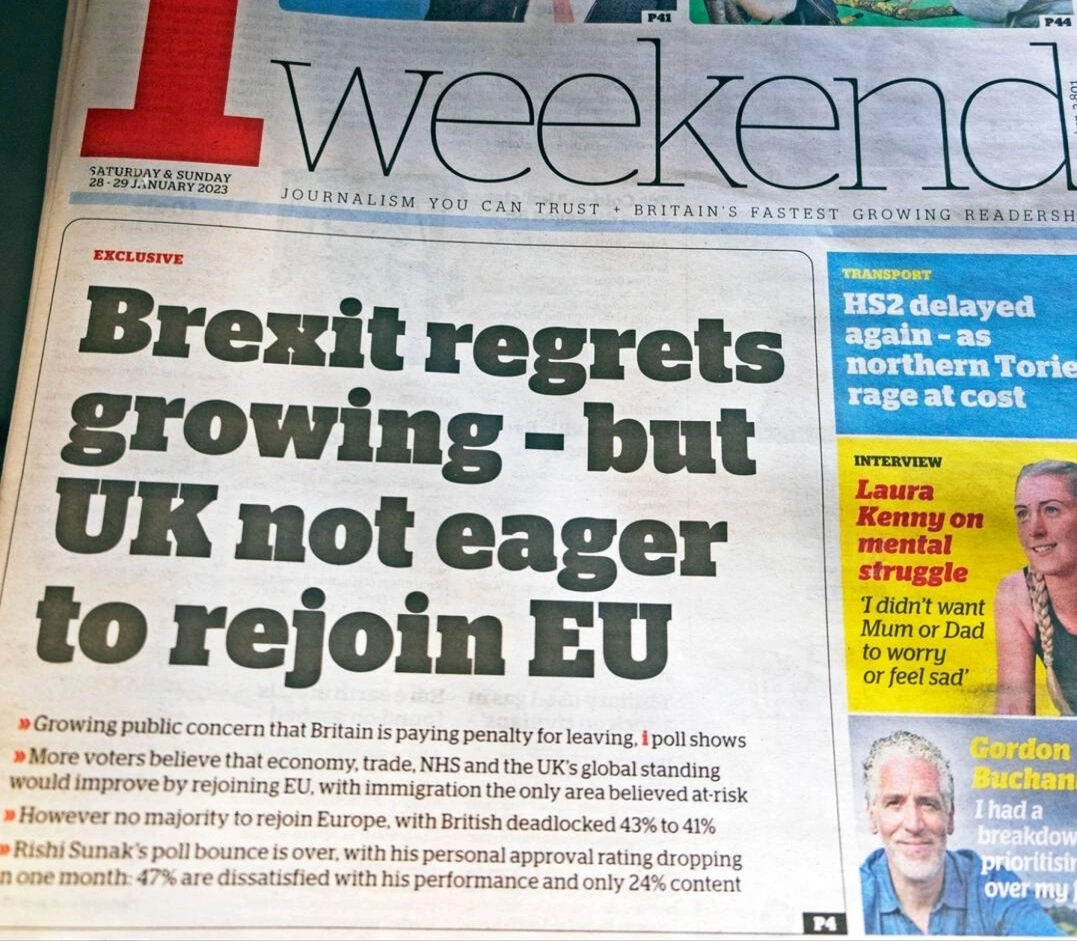
Recent polls reveal Brexit Regret in the UK. Public support in Britain for rejoining the European Union has reached an all-time high. Beyond the general public, political leaders in Scotland, Wales, and Northern Ireland have explicitly stated that their nations’ futures lie “within the European Union.”
This common understanding within the region reveals the wide gulf that Brexit has created; an exercise that should have promoted unity has ended up dividing the country. This is the result of Westminster’s wrong policies.
Brexit Regret in the UK: Traveling through Time to Avoid Brexit
We can all agree that Brexit hurts the economy. It’s the cost of rejoining the EU that we disagree on. Reintegrating with the EU is the best way to reverse the damage. However, with plenty of winners as well as losers, the decision is not clear-cut. Brexit has been a slow drag on growth rather than causing a sharp recession – which the Treasury wrongly predicted during the referendum campaign – and that muddies the waters further.
Some estimates are better than others, though. Brexit supporters often point out that Germany’s growth has been weaker than the UK since 2016. This is despite being an EU member, and they say Brexit has made no difference. But Germany has had its own economic problems to deal with; the biggest being Chinese imports of German machinery and cars falling rapidly since 2018.
So, we need to look more widely. One possibility is to take the average growth of the G7 – big, advanced economies that didn’t leave the EU. The UK has underperformed the G7 average by 2.5%. But the G7 includes rapidly aging, slow-growing Japan and Italy. Between 1997 and 2016 – except for the big crash in 2008-9 – Britain tended to grow faster than the G7 average.
Brexit Regret in the UK: UK Poorer than Others
Brexit Regret in the UK is clear from the lack of progress in the country. A lot of things happened in other countries that had nothing to do with Brexit. For example, there are the US tech boom, Germany’s stagnation, and Norway’s huge profits from the 2022-3 energy crisis.
Therefore, Bloom’s group zoomed in on British companies, comparing those that trade a lot with the EU with those that do not. It found that the sales of EU-facing companies grew more slowly. It estimates that UK gross domestic product was 6% smaller at the end of 2024. That’s an annual loss of about £2,500 a person.
The cross-country and cross-company evidence says Brexit has made the UK significantly poorer. That’s borne out by other evidence too: stagnating business investment, which had been recovering between 2009 and 2016; goods exports that slumped after Brexit and are still lower than they were in 2016; and weaker services trade with the EU. The CER’s latest modeling shows that Brexit has reduced financial services exports to the EU by about 25%.
The UK’s Biggest Losers: Brexit Tightening Circle of Earnings
The UK’s farmers, fishers and food manufacturers are by far the biggest losers. They’ve seen exports to the EU fall by about 30%. This is because there are many checks on the EU border to ensure imported food is safe to eat. If we take the OBR’s (Office for Budget Responsibility) assumption that Brexit will reduce the size of the economy by 4% by 2030, that involves about a £40bn hit to tax revenues. That compares with tax rises between 2019 and 2030 of about £150bn. If the OBR is right, a fair chunk of those tax rises would not have been needed.
The UK was the biggest destination for EU citizens taking up their free movement rights. Since Brexit, more EU citizens have left the UK than arrived. And there are now 35,000 fewer EU students than before Brexit, with many balking at having to pay high international fees. Another issue is Danish sand eel fishers.
The UK has banned sand eel fishing in its waters, in part to protect puffins. The Danish fishing fleet tried and failed to overturn the decision.
Brexit Regret in the UK: Polls to Support reversing Brexit
All constituencies (except four constituencies) in Great Britain would support reversing Brexit and rejoining the EU, new polling has shown. Andy Burnham seeks to build a deeper relationship with the bloc and to win over voters. New constituency-level polling of 11,927 UK voters found EU membership was by far the most popular policy option, with 35 percent of people stating it as their preferred government proposal when it came to Britain’s approach to the bloc.
The YouGov poll commissioned by Best for Britain found 18 percent backed the UK government’s current position of seeking a closer relationship with the EU, but within the government’s red lines, and just 11 percent would prefer to loosen ties to the EU.
The poll places pressure on the prime minister to rethink Labour’s red lines on renegotiating Britain’s relationship with the EU. Campaigners suggested the survey provides the party a “clear opportunity” to boost support in the next general election by growing closer to Brussels.
The polling, seen exclusively by The Independent, found that restoring EU membership is the most popular approach in all constituencies, except four Reform UK- and Restore Britain-held seats – Ashfield, Clacton, Great Yarmouth and Boston and Skegness.
EU Membership: A Foggy Horizon
EU membership being the most popular UK-EU relations policy in all but four (628) parliamentary seats in Great Britain, on central estimates, including in Makerfield, the Prime Minister’s seat, across the country, people were most likely to say they want the UK government to propose the UK’s membership of the EU.
Support was strongest among Labour, Liberal Democrat and Green Party current supporters, with 55%, 56% and 67% respectively choosing the membership option. The new poll surveyed upwards of 11,000 voters, from 628 constituency seats. Participants were asked to identify which EU relationship they want the British government to propose, with a major UK-EU deal now on the horizon. Among the seven options, one proved more popular than most. Out of 628 constituencies, 624 ‘would vote to rejoin the EU’
Brexit Regret in the UK: Public Desire Vs. Leaders’ Reluctance
61% of Britons now say they would vote to rejoin the European Union, compared with 39% who declare they would stay out. That is the highest figure that it has been, as an average over any extended period of time, all the way back to 2016.
Public opinion has shifted quite considerably. It is partly for demographic reasons, even though prior to 2024, apart from the Greens and the nationalists, nobody was arguing in favour of rejoining. The shift in public attitudes on Brexit has occurred in spite of some political leaders’ reluctance to make the case for rejoining the EU.
However, the vast bulk of the enormous damage to the UK economy from Brexit comes from the two key elements of the Conservative hard Brexit: loss of smooth trade with the country’s biggest trading partner and the ending of free movement of people between the UK and the European Economic Area.