State Pension Triple Lock: Burnham’s Pension Reform and the Cost of Social Care
The proposal by Andy Burnham to reform the State pension triple lock from 2030 has been one of the
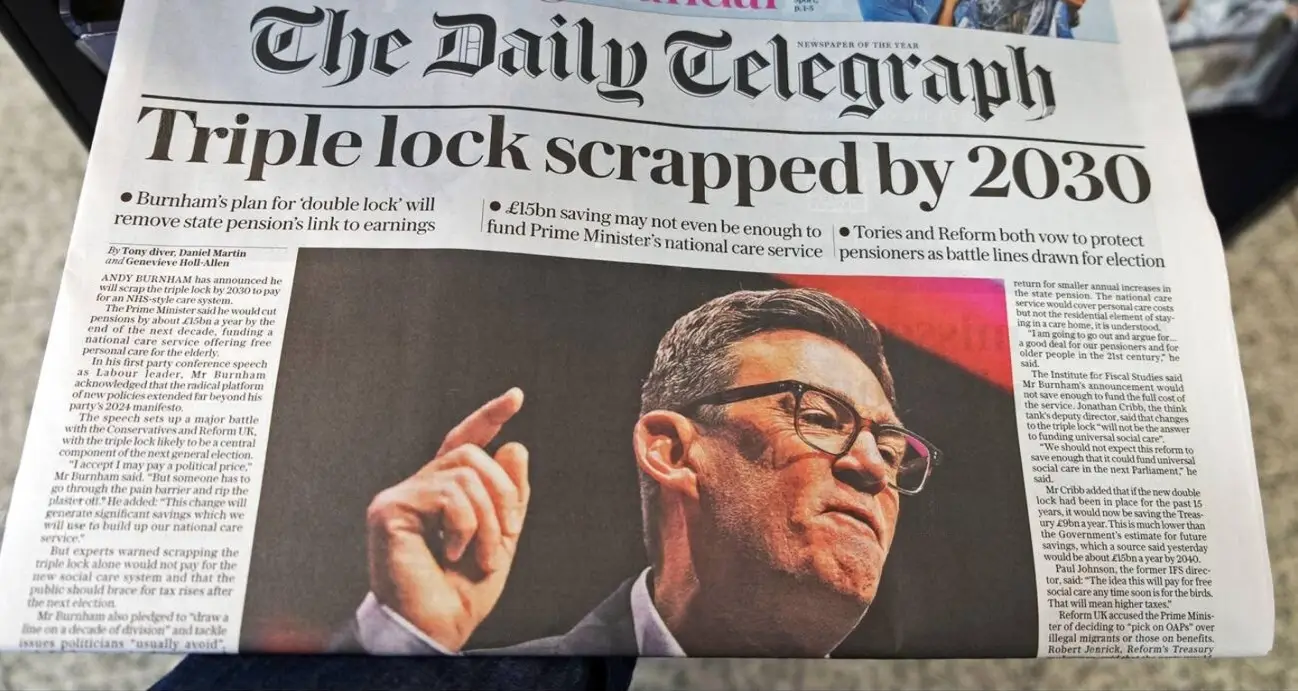
The proposal by Andy Burnham to reform the State pension triple lock from 2030 has been one of the most important fiscal trials of his economic agenda. The policy has been a protective measure against any sharp decreases in the real value of pensioners’ income since 2011. At the same time, the scheme has increased uncertainty about the cost of the State pensions in the future.
Currently, under the scheme, the State pension increases each year by either inflation, average earnings growth, or 2.5%—whichever is highest. In other words, the rule has helped pensioners stay on track with inflation and average earnings.
It has also contributed to increasing pension expenditure over time. The amount of pension expenditure has grown quite significantly. His proposal ties pension reform directly to the future of social care. The article discusses Burnham’s proposal regarding the reform of State pension triple lock and social care financing.
How the State Pension Triple Lock Would Change
Burnham has promised to keep the existing system until April 2030. After that, he wants to remove the yearly link with average earnings. Pension increases would then follow either inflation or 2.5 percent, whichever is larger.
The government does not call this a cut to pension protection. It says the new system will have a rule that keeps the pension value compared with earnings over time. If earnings rise sharply, the State Pension could get increases to keep that relative value. This difference matters.
Burnham is not proposing to freeze pensions or lower their cash value. He wants to change how future increases are calculated. The main question is whether the new system can guard against inflation while giving the Treasury predictable spending.
The government says the change would also save money for a National Care Service. That means pension reform is part of a plan for Britain’s welfare state.
Reasons for the Fiscal Problem of State Pension Triple Lock Spending
There has been a substantial rise in the amount of state pension as a result of the triple lock. According to the analysis conducted by the Institute for Fiscal Studies (IFS), the new state pension is much higher compared to what it would be if it had been linked to average earnings since 2011.
This policy creates uncertainty. Inflation can go up due to an energy crisis, and similarly the rate of wage growth can become higher for reasons that may not necessarily last. When one of these increases significantly, the government needs to use the highest number according to the current system.
According to the Office for Budget Responsibility, state pension spending will increase by a considerable amount over the next few decades.
The Link to a National Care Service
Burnham wants to use savings from pension reform to build a National Care Service. His government has described the service as a system that would provide care free at the point of use based on need rather than ability to pay. The proposal would address one of Britain’s running social policy problems.
Many families face costs when relatives need long-term care. The pressure also affects the NHS because inadequate social care can make it harder to discharge patients from hospitals.
The government says it will introduce the care service in stages. It will not finance the programme through borrowing. Instead, ministers plan to build the service as savings from the adjusted pension system grow.
Officials estimate that the pension changes could save around £15 billion a year by the end of the 2030s. The figure could rise to about £50 billion a year by 2050.
The Gap between Savings and Social Care Costs
Some estimates put the annual cost of a comprehensive social care system at around £18 billion. That figure creates a challenge for Burnham’s plan. The pension reform could eventually produce savings, but those savings will not arrive at the same speed as the costs of a new care system.
IFS analysis published after Burnham’s announcement warned that the government’s £15 billion estimate for 2039-40 partly reflects inflation. In today’s money, the annual saving would be closer to £11 billion.
The IFS also estimates that the actual saving could vary widely because future earnings growth is difficult to predict. Its analysis suggests that the annual saving in 2039–40 could range from about £4 billion to £20 billion. This uncertainty matters because social care requires funding.
Intergenerational Question of Fairness
The debate also involves a broader issue of fairness among generations. Pensioners have enjoyed extensive protections through the triple lock. On the other hand, young workers struggle with high housing costs, inadequate opportunities to buy their own homes, and increasing budget pressures.
Therefore, Burnham talks about pension reforms as part of a broader deal that allows protecting the older generation, but at the same time building up a system of care which will assist people once they grow old as well. However, such a change may cause problems for pensioners.
The triple lock for the state pension has become an essential safety net since it provides a specific mechanism for annual increases. Elimination of the earnings component means future increases will not be automatic anymore.
Nevertheless, that does not imply that pensioners would lose their money.
An Alternative Approach
The debate cannot conclude with either retaining the current system or scrapping it altogether. The debate over the State Pension Triple Lock also needs to consider alternative solutions.
The Institute for Fiscal Studies (IFS) is offering an alternative solution that is premised on the “smoothed earnings link” model. In this case, the state pension will be determined by a targeted percentage of average earnings.
During normal economic times, the pension will rise with earnings, but when there is inflation that exceeds earnings growth, then it will be linked to inflation and, as such, will allow the pension to revert to its targeted link with earnings as wages improve. While the solution is bound to pose a challenge to the government, it will certainly reduce its reliance on the highest growth among the three indices.
Political Risk for Burnham
The change is politically tricky. The State Pension Triple Lock remains a sensitive issue for Burnham because any reform could affect public confidence among pensioners.
Burnham himself admits that he may bear political risks for the implementation of such a reform. Already there have been disputes in the Labour Party on the issue when the trade unions have asked themselves whether pensioners should contribute to paying for social care.
The problem here is that pensions concern a lot of people, and thus any reform becomes a matter of a big discussion about the issues of justice, safety, and relations between different generations.
Notwithstanding that, no changes mean that the pressure will be present anyway as the cost of both pensions and social care is going to grow.
A Test of the Government’s Economic Strategy
The State pension lock has become more than a technical pension policy. It now sits at the centre of a debate about public spending, social care and intergenerational fairness. Burnham’s proposal tries to connect these issues.
The government wants to reduce the unpredictability of pension spending and use part of the savings to develop a National Care Service. That gives the reform a social purpose.
The government expects savings in the long term while independent analysis shows that the actual amount could vary significantly. The cost of care could also remain above the savings available in the early years.
A Difficult Welfare Trade-Off
Burnham’s pension reform represents a test of how his government intends to manage Britain’s welfare state. The existing triple lock has protected pension incomes. Raised their value over time, but it has also increased pressure on public finances.
The proposed change could make pension spending more predictable. Provide resources for a National Care Service. The funding gap, uncertainty over future savings and concerns about intergenerational fairness mean that the policy will require more than a political announcement.
The key question is therefore not simply whether Burnham should change the pension rules. It is whether his government can create a long-term system that protects pensioners, funds care and keeps public finances under control at the same time. The State pension triple lock debate will remain central to that question.