
UK’s Military Support for Saudi Arabia: Beyond Security?
In an announcement made on 20 October 2026, the British government intends to offer more military assistance to Saudi
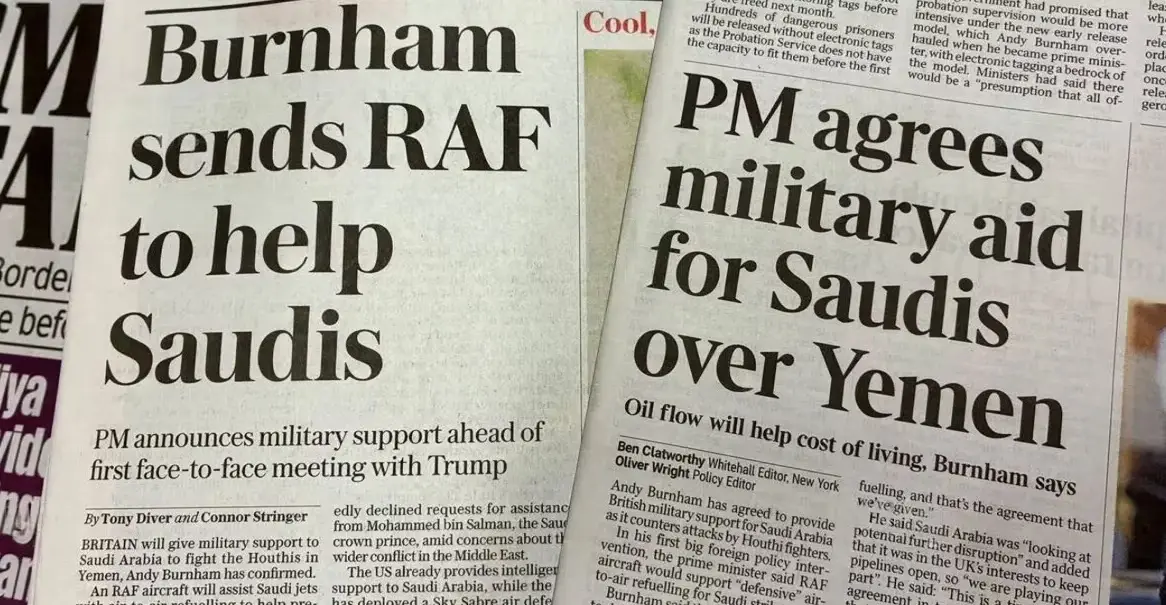
In an announcement made on 20 October 2026, the British government intends to offer more military assistance to Saudi Arabia. The Royal Air Force (RAF) Typhoon fighter jets will conduct defensive air patrols over Saudi Arabia to assist in the interception of missiles and drones fired at them by the Houthis from Yemen. In addition, an A400M cargo plane and military advisors will be deployed by the UK to aid Saudi forces. The latest decision has renewed debate over the UK’s military support for Saudi Arabia and the possible consequences of a wider British role in the region.
Military Support Provided by the UK to Saudi Arabia: A Long-Time Collaboration
The collaboration between the UK and Saudi Arabia concerning military issues has been ongoing for decades. Over the years, the UK has offered the kingdom significant weapons systems, such as the Tornado aircraft and Eurofighter Typhoons in a later time.
Following the involvement of the Saudi-led coalition in Yemen in 2015, the UK continued to offer bombs and missiles to the kingdom. Other types of military aid, which included offering aircraft parts, were also provided.
Activists have warned that continued arms supplies could have serious consequences. They argue that the UK may bear some responsibility for the impact of the Saudi-led air campaign.
Even when there was a ceasefire in 2022 and reduced cross-border conflict, cooperation and arms trade went on. This continued cooperation has kept the UK’s military support for Saudi Arabia at the centre of debate over Britain’s role in Yemen.
The Changing Role of the UK’s Military Support for Saudi Arabia
According to the Ministry of Defence, the above-mentioned measures are an answer to the growing Houthi missile and drone attacks. According to the stated policy, RAF Typhoons will be used to conduct defensive counter-air operations for the protection of Saudi cities.
The planes will be able to intercept the incoming missiles and drones from the air. However, the government states that they will not conduct offensive strikes against the ground Houthi bases.
The aircraft of type A400M will be used for transportation of defence equipment within the territory of Saudi Arabia. The advisers of British troops will also assist Saudi staff officers. The air-to-air refuelling operations of the UK will last for an additional period of 90 days. Hence, the increased military support by the UK results in new duties.
The Potential for Escalation of the Regional Crisis
This is happening during a time when there is still some level of instability in the Middle East as well as the ongoing crisis in Yemen. Tensions between Saudi Arabia and the Houthis remain high. An attack by either side could trigger retaliation from the other.
According to officials in Britain, providing aid to Saudi Arabia in defending its territory means preventing any potential escalation.
Some people, however, say that increasing foreign troops increases the possibility of getting more involved in the conflict. What is important in this case is the difference between defence and offense; the broader implications, however, will be based on what happens next.
The future of the UK’s military support for Saudi Arabia will depend partly on whether the defensive mission remains limited or leads to deeper involvement.
The Issue of Human Rights and the Reputation of Britain as an International Actor
Saudi Arabia’s human rights record has faced criticism for many years. Various international organisations and advocacy groups have raised concerns about the situation.
This criticism covers political repression, treatment of protesters and the Saudi-led military operation in Yemen. Various human rights organizations have expressed their concern over the negative impact that the operation is having on civilians.
There have also been calls for investigations into breaches of international humanitarian laws. These issues raise political sensitivity around increasing military cooperation with Saudi Arabia. For critics, the UK’s military support for Saudi Arabia also raises questions about Britain’s responsibility for the wider consequences of the conflict.
Why Diplomacy Must Remain Central?
Military assistance may help protect Saudi cities from immediate aerial attacks, but it cannot by itself settle the conflict in Yemen. A lasting solution requires political engagement, negotiations between the parties and efforts to address the humanitarian crisis.
The British government has acknowledged that military action alone cannot provide a lasting solution. It says it continues to support a political process led by the United Nations.
That position needs to guide Britain’s actions, not simply accompany them. The government should use its relationship with Saudi Arabia to encourage restraint and support meaningful diplomatic efforts.
It should also maintain channels for de-escalation and avoid allowing a limited defensive mission to become an open-ended commitment. The UK’s military support for Saudi Arabia should not be treated as a substitute for a political strategy.
Balancing Alliances with National Interests
Britain’s decision to deploy RAF Typhoons on defensive missions over Saudi Arabia marks a further expansion of its involvement in regional security. The government says the move will protect civilians and critical infrastructure from Houthi missiles and drones.
However, the move also brings operational risks and raises questions about human rights. It could draw Britain further into a conflict that has already caused severe suffering in Yemen. Providing military support to an ally that is unpopular in Britain, without any effort for a political solution, not only fails to resolve the crisis but also draws Britain further into regional tensions and imposes heavy costs on the country.
The UK’s military support for Saudi Arabia should therefore be subject to clear limits, regular review and a strong commitment to diplomacy. Britain needs to maintain its defence partnerships while protecting its own security interests.
It must also ensure that military resources are used responsibly and that its actions comply with international law. Protecting an ally from immediate threats may serve a short-term purpose, but lasting regional security will depend on political progress rather than military support alone.